Introduction
In today’s competitive telecom industry, customer retention is crucial. Losing customers not only impacts revenue but also incurs higher acquisition costs. In this case study, I demonstrate a comprehensive Telecom Customer Churn Analysis using a multi-page Power BI report. This analysis leverages data analytics to understand churn drivers, segment customer demographics, assess contract and service utilization, and identify high-risk customers for proactive retention measures.
Project Objectives
- Identify key factors influencing customer churn.
- Segment customers based on demographics, contracts, and service usage.
- Analyze customer support interactions as potential churn drivers.
- Highlight high-risk customer segments for targeted retention strategies.
- Present actionable insights through interactive dashboards.
Data & Methodology
The analysis uses a telecom customer churn dataset comprising over 7,000 records. The data model is built using a star schema:
- Fact Table: FactCustomerChurn (storing transactional data like tenure, monthly charges, support tickets, and churn flag)
- Dimension Tables: DimCustomer, DimContract, DimService, and DimSupport provide detailed attributes for customer demographics, contract details, service utilization, and support interactions.
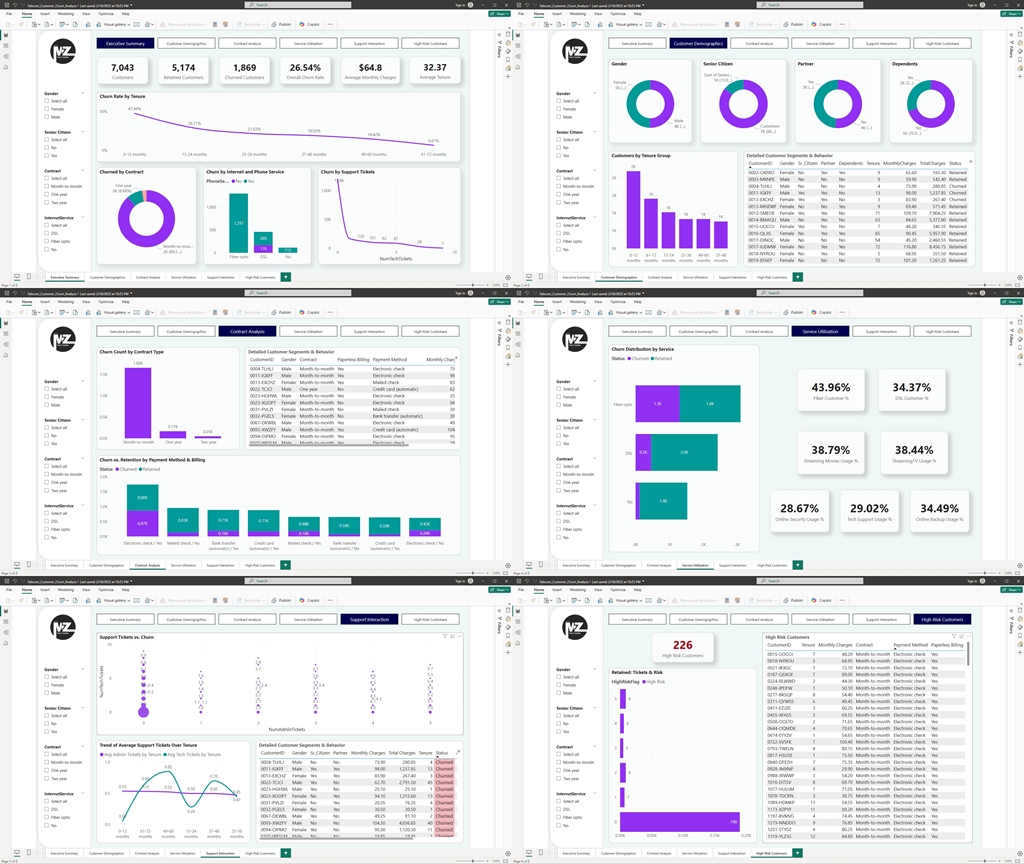
Using Power BI, I developed a six-page interactive report with multiple visualizations and KPIs that enable business stakeholders to quickly grasp key trends and drill down into detailed insights.
Page 1: Executive Summary
Overview:
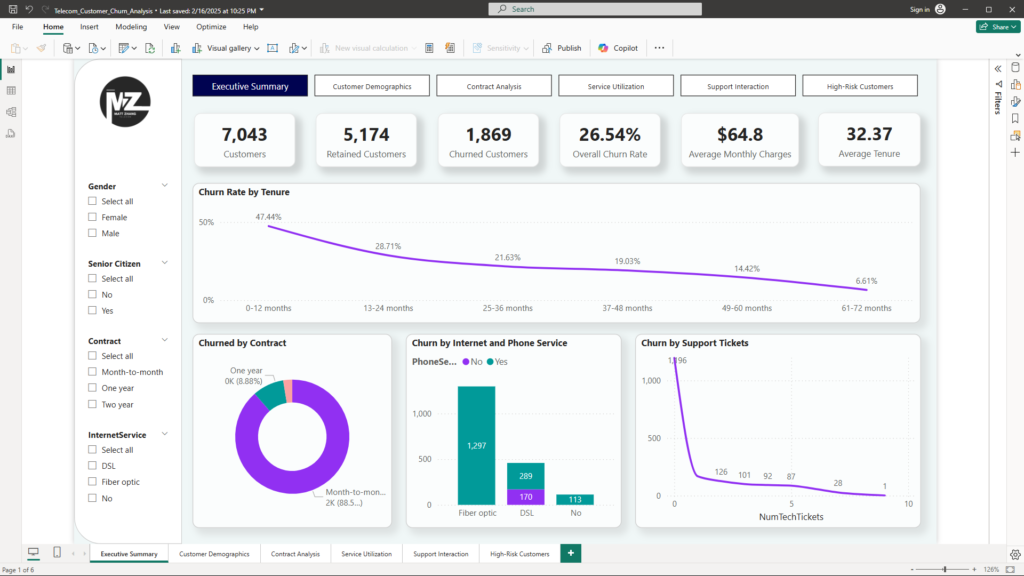
This page serves as the report’s gateway with a high-level view of overall performance.
Key Elements:
- KPIs:
- Total Customers, Retained Customers, Churned Customers
- Overall Churn %, Average Monthly Charges, Average Tenure
- Visualizations:
- Churn Rate by Tenure (Line Chart): Shows how churn varies over different customer lifecycles.
- Churned by Contract (Donut Chart): Illustrates the distribution of churned customers across various contract types.
- Churn by Internet and Phone Service (Stacked Column Chart): Displays churn distribution based on service usage, pinpointing areas for service improvement.
- Churn by Support Tickets (Line Chart): Demonstrates trends between support interactions and churn likelihood.
Benefits of the Executive Summary:
- Quick Insights: Provides a snapshot of key performance indicators, allowing executives to rapidly assess overall business health.
- Strategic Overview: Highlights the most critical areas impacting churn, setting the stage for deeper analysis.
- Actionable Metrics: Facilitates immediate identification of performance gaps and opportunities for retention efforts.
Page 2: Customer Demographics
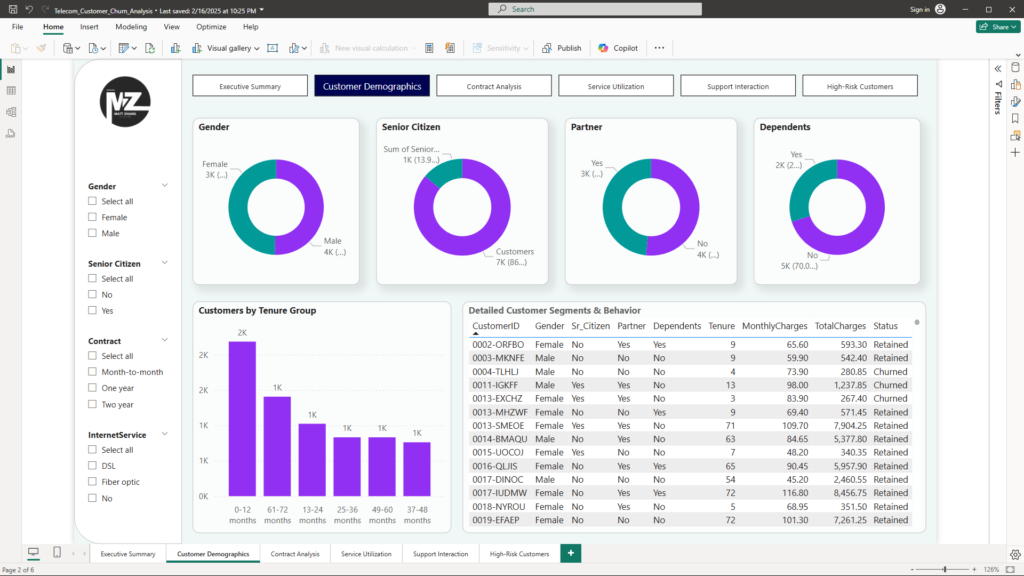
Overview:
Understanding who the customers are is critical for effective segmentation and tailored retention strategies.
Visualizations:
- Donut Charts: Show the distribution of customers by Gender, Senior Citizen status, Partner, and Dependents.
- Customers by Tenure Group (Column Chart): Groups customers into tenure buckets to analyze retention behavior across different lifecycle stages.
- Detailed Customer Segments & Behavior (Table): Provides a granular view of customer profiles for deeper insights.
Benefits of the Customer Demographics Report:
- Enhanced Segmentation: Enables identification of key demographic groups, supporting targeted marketing and retention strategies.
- Customer Profiling: Provides a detailed breakdown of customer characteristics to understand behavior patterns.
- Customized Engagement: Helps tailor communication and service improvements to different customer segments.
Page 3: Contract Analysis
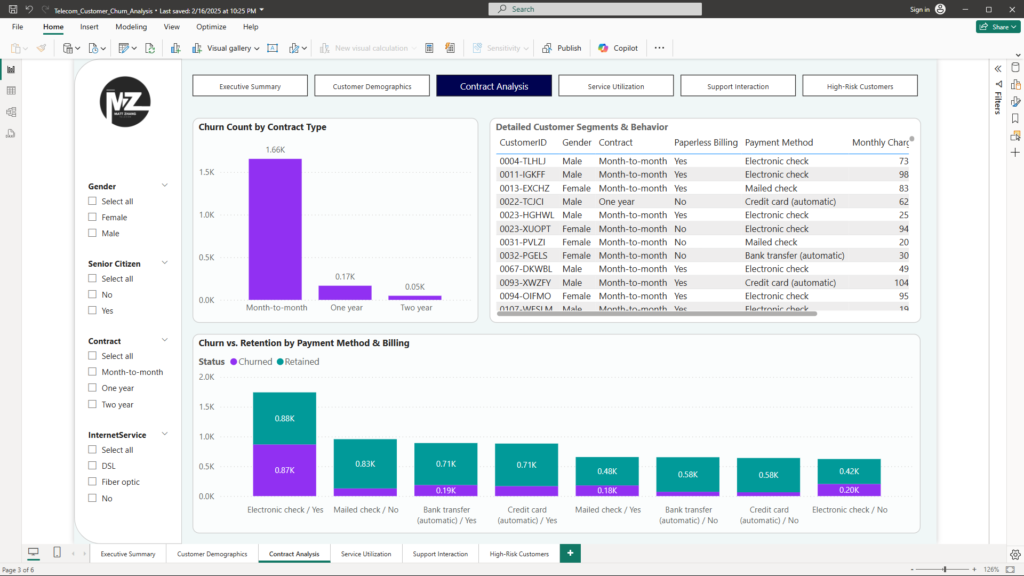
Overview:
Contracts are a critical driver of churn. This page focuses on contract-based segmentation and its impact on customer retention.
Visualizations:
- Churn Count by Contract Type (Column Chart): Quantifies the number of churned customers per contract category.
- Detailed Customer Segments & Behavior (Table): Offers detailed breakdowns by contract attributes.
- Churn vs. Retention by Payment Method & Billing (Stacked Column Chart): Compares retention rates across various payment methods and billing preferences.
Benefits of the Contract Analysis Report:
- Risk Identification: Pinpoints which contract types are most vulnerable to churn.
- Incentive Planning: Supports development of targeted incentives (e.g., promoting longer-term contracts) to improve retention.
- Payment Insights: Provides clarity on how payment methods influence customer loyalty and churn.
Page 4: Service Utilization
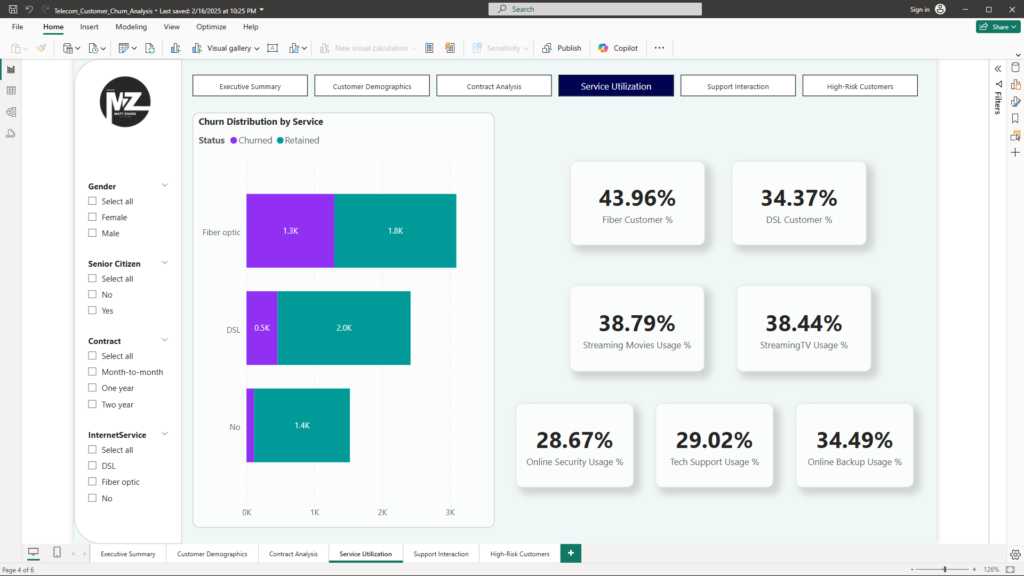
Overview:
This page evaluates how service usage correlates with churn, helping identify opportunities to enhance customer satisfaction.
Visualizations:
- Churn Distribution by Service (Stacked Bar Chart): Analyzes churn across different service types (internet, phone, streaming) to identify service-specific issues.
- KPIs (Cards): Display key metrics on service utilization for quick reference.
Benefits of the Service Utilization Report:
- Operational Efficiency: Highlights which services are underperforming in retaining customers.
- Service Improvement: Drives targeted initiatives to improve service delivery and customer satisfaction.
- Strategic Allocation: Supports decision-making on where to invest in service enhancements.
Page 5: Support Interaction
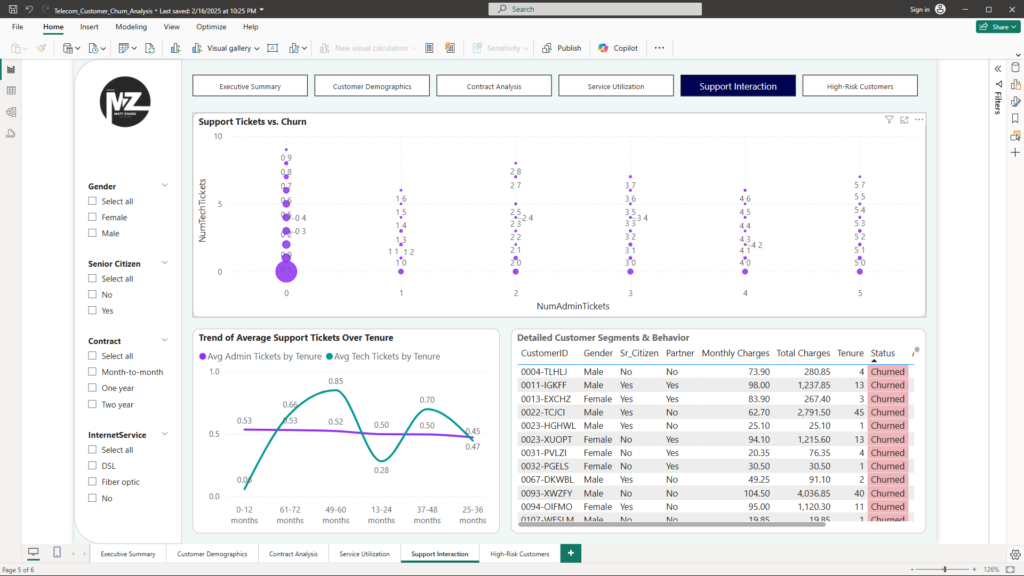
Overview:
This page explores the impact of customer support interactions on churn, providing insights into how support quality and responsiveness influence retention.
Visualizations:
- Support Tickets vs. Churn (Scatter Plot): Examines the correlation between the number of support tickets and churn likelihood.
- Trend of Average Support Tickets Over Tenure (Line Chart): Tracks how support interactions evolve as customers age with the company.
- Detailed Customer Segments & Behavior (Table): Lists customer details alongside support ticket counts.
Benefits of the Support Interaction Report:
- Customer Experience: Reveals if and how support issues drive customer dissatisfaction and eventual churn.
- Proactive Management: Enables early intervention by identifying customers with high support ticket volumes.
- Service Quality Assessment: Provides data-driven insights to improve support processes and enhance customer satisfaction.
Page 6: High-Risk Customers
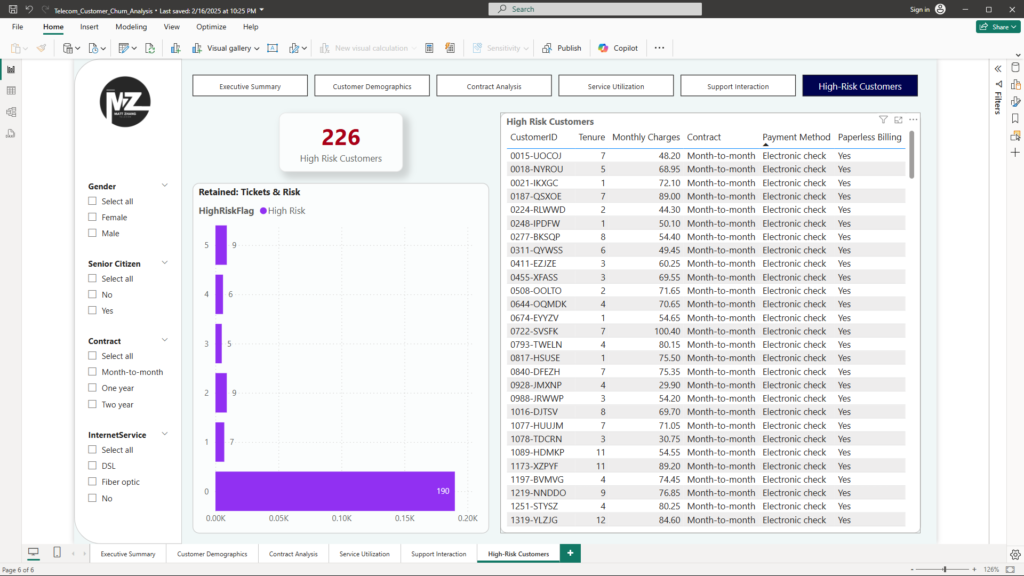
Overview:
Focusing on actionable insights, this page identifies high-risk customers for targeted retention initiatives.
Visualizations:
- Retained: Tickets & Risk (Bar Chart): Visualizes the interplay between support interactions and risk profiles among retained customers.
- High-Risk Customers (Table): A detailed listing of customers flagged with a high risk score, enabling focused retention campaigns.
Benefits of the High-Risk Customers Report:
- Targeted Action: Quickly identifies customers most at risk of churn for immediate retention efforts.
- Resource Allocation: Supports prioritization of resources toward high-risk segments.
- Strategic Intervention: Informs tailored retention strategies based on customer behavior and risk profiles.
Filters & Interactive Elements
Across all pages, interactive filters and slicers have been implemented to allow stakeholders to dynamically segment data:
- Slicers for:
- Contract Type
- Internet Service
- Payment Method
- Tenure Buckets
Overall Benefits:
- Dynamic Analysis: Users can drill down into specific segments to explore detailed trends.
- User-Friendly Navigation: Interactive elements enhance the overall user experience, making the dashboard accessible and actionable.
- Informed Decision-Making: The combination of detailed visualizations and dynamic filters ensures that stakeholders have the insights needed for data-driven decisions.
Conclusion
This Telecom Customer Churn Analysis demonstrates the power of data analytics in uncovering customer behavior patterns and driving actionable insights. By leveraging a multi-page Power BI dashboard, stakeholders gain a comprehensive view of churn dynamics—from high-level KPIs to detailed customer segmentation and risk analysis. This case study not only showcases technical expertise in data modeling, DAX measures, and interactive visualizations but also provides a strategic framework for enhancing customer retention in the telecom industry. For more information on my data analytics projects or to discuss potential collaborations, please feel free to reach out via email at mail@ssghosal.com.